A. Faith Brummel
A few years ago, our family moved to a hobby farm in the countryside by the little town of Medaryville. As expected our hobby farm came with a clowder of cats. There were grey, brown, and white cats. I was twelve years old and thought how amazing it would be to tame the feral cats. The previous owner of the farm had always fed the cats, so I carried on the tradition. The cats were so afraid of me that they would not even come to eat their food if I stood nearby. But, I did not give up trying to tame the cats.
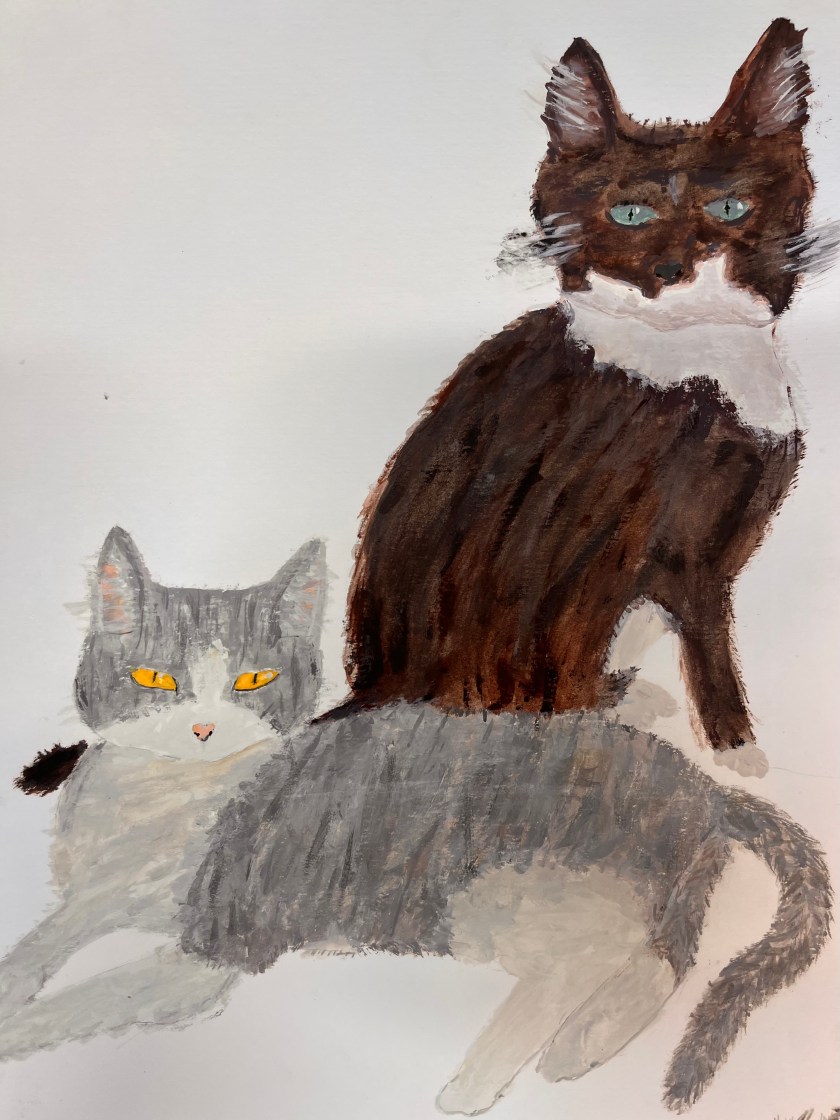
My favorite cat, which I had only seen from a distance, was completely grey. In the morning light, she was like the mist the creeps along the ground. Thus, I christened her Misty Martha. Another female cat was grey with white splotches splattered over her fur. I named her Margaret. Over the next few months, I sat by their food bowl. Slowly they began to relax and eat in my presence. Misty Martha was the calmest around me. One day I reached over and let my hand run over her fluffy fur. She jumped onto the dog kennel and hissed at me. I continued trying to touch the cats. Before long Martha would rub against my legs, but still rejected my attempts to pet her.
One day, not long after, Martha disappeared. Soon after, Margaret did the same. I concluded that they had both given birth to kittens. Over a few weeks, they had grown quite plump. I had attributed it to them catching mice. Then two days later Martha and Margret reappeared looking gaunt with their ribs showing under their fur. I searched for kittens but came up dry. Weeks later I spotted Margret her little tribe. Both Margaret and Martha had four kittens apiece. My goal shifted from befriending the mothers, to befriending the kittens. I wait inside the feeding room where I pounced on the unsuspecting kitten. They struggled in my arms and left red streaks across my epidermis. But I did not let go. I waited until it grew tired of resisting and then petted its soft baby fur. Several of the kittens grew more friendly towards me and began to rub against my legs. But, they ran away or scratched me if I tried to pick them up. I named the friendliest kittens Barnelia, Moustachia, and Tiger.
Toward the beginning of fall, I noted that two of the male kittens had gone missing. I later learned that male kittens would run off to find a domain of their own and never return. Days later, I found a dead kitten by a fence and another lying stone cold in the lawn. The sad sight had me running to the house into my father’s comforting arms. Why were my little kittens that I had doted on for months suddenly dying? At least the three friendliest kittens were still alive, and rubbed against my rubber-booted feet, when I went into the barn. In the early winter, I saw my favorite kitten, Moustachia, lying still on the hay. I ran inside, tears pouring down my face. Why did my favorite animals need to die? My mother consoled me, “You still have Tiger. Enjoy her!” Of the eight kittens that had been born that spring, only one lived to see the tulips bloom the next spring.
The surviving kitten was Tiger. She had brown and white streaks through her fluffy fur. But she resisted my caresses. Soon she grew plump about the middle. One Sunday afternoon I ran back to the farmhouse shouting, “Tiger has two kittens.” I found her cuddled up with two kittens in a mound of old hay. I could tell she was fatigued from the labor. Her eyes were glazed with weakness. I cracked a still-warm egg into an old dog dish and let Tiger lap up the egg. I tucked more hay around the two little lumps of fur. The kittens were no bigger than a mouse. But Tiger had not appreciated my visit and moved her babies to a less warm and comfortable place to raise her young: The wood pile. Neither of the kittens survived that dreaded crib, and Tiger was again childless. That Fall, she conceived and bore three kittens, but she hid them away so well that I never found them.
During that winter, Tiger finally became more friendly. She would curl up at my feet as I milked my cow. She would rub against my legs while I collected egg, and would sometimes sit on my lap. She became my close friend, and when the warmer months came, her belly swelled again, and so did the expectation for spring kittens. On a rainy morning, I found her nestled in the wall of the barn with four little kittens moving at her belly. Tiger’s purrs of contentment vibrated the wall. Every morning as I did my chores I would take a moment to peek in on the growing kittens. I smiled when I saw their little blue eyes blink back at me. Two of the kittens were black and white, one was grey, and the fourth kitten had brown stripes over its back. There were three boys and one girl. But alas, they become infected with the common cat cold. They started to sneeze and cough. But they were strong enough to pull through. When the kittens continued to grow, Tiger moved them into a mold-covered doghouse in the back of the barn. There, the kittens could walk around and learn to play.
When the four kittens were around 3½ weeks old I was outside one night enjoying the Aurora Borealis. The sky was lit up with purple and green streaks. But even with such beauty in the sky, I kept glancing around, hoping to see Tiger. As usual I went to check on the kittens that evening as I did my chores. Tiger had been missing. Goose bumps covered my arms so I ran inside for my coat. I asked my parents if they had seen Tiger. Their answer was “No.” Then my dad piped up with little tact, “There is a dead cat down the road. We saw it when we were on our bike ride.” My heart dropped into my stomach as I raced down the road to find my beautiful Tiger lying stiff and cold by the edge of the road. My eyes blurred under the beautiful purple and green streaked sky. I walked back to the barn where those four little kittens were crying of hunger. I picked them up and snuggled them close to my heart. In that moment, I knew that I would assume the role of mother to those kittens.
It had been 9:00 pm when I found Tiger’s still body. The little felines had most likely been without milk for 5-6 hours. I packed them all into a rubber tote and brought them inside the house. I was almost to the cellar when my mother spied the tub of kittens and said, “Don’t bring them inside, they will cry all night and keep us up. I will be itchy all over you know I’m allergic to cats.”
“But mom,” I protested, “they’re so little They will get cold outside. I don’t want to go outside in the middle of the night to feed them. I was just going to put them in the cellar.” After further discussion, my mom gave in to my supplication, and I triumphantly carried the kittens down the broken, cement steps to the cellar. It was cool down there but not cold, and I nestled the tub of squeaking kittens next to a basket of potatoes.
Now it was time to feed the kittens. I hurried back upstairs to put some of our fresh cows milk into a low bowl and heated it in the microwave. I only spilled a drip or two on the way down the stairs. I placed the warm milk in a bowl by the kittens. I dipped their little snouts into the fluid. But their tongues did not lick the milk away. I tried again and again, and only succeeded in making their cries louder. I decided that they were too young to comprehend the concept of licking something out of a dish.
I rummaged through a drawer looking for another way to feed the kittens. I found an eye dropper. I washed it and filled its tiny glass tube with milk and put it in the smallest kitten’s mouth. I pinched the rubber end to eject some of the liquid, but the kitten spurned my attempts to give it the nutritious milk. The milk ran into its fur. I picked up each kitten in turn, injecting a drop of milk into its mouth. Finally, one of the kittens caught on and started sucking on the end of the eye dropper. At two in the morning, I was startled from my sleep by an alarm. I stumbled down the stairs, half asleep, with the loud buzz of the microwave echoing in the empty kitchen. I fed the kittens in that early morning silence and fell back into bed.
The next morning, I came trapsing down the stairs, still tired from the night’s work. I muttered a hasty “good morning” to my father. I was just about to go down the stairs with the eye dropper and container of warm milk when he said, “You look tired. Don’t you think you should dispose of them? I don’t need my daughter to…”
I interrupted, “Dispose of them? Dad, I couldn’t do that. I need to take care of them even if I am tired.” I added quietly to myself, “I promised that I would take care of them.”
I named Teddy, Tilly, Aven, and Agnas them that afternoon, wanting to have a greater connection with them.
A week later I moved the kittens out to the barn. They took on the life of a farm cat. One day, I noticed that, Tilly and Agnas, were looking sick. Their eyes and noses were ejecting mucus. I thought nothing of it. It was only a common cat cold and would clear up soon. But the following day, I gasped as I saw that the breath of life had gone out of Tilly. I ran inside feeling weak from grief. I watered my pillow.
The following Sunday, the preacher and his wife came over for lunch. His wife loved the kittens and was continuously petting them. As the preacher stepped out the with his cowboy boots, he landed right on the stop where Teddy was taking his afternoon nap. My sweet, dear Teddy deserved a full and happy life, but that was not to be. The shock of my dear baby kitten dying so suddenly caused waves of grief, but I was consoled by the gentle purrs of Aven and Agnas.
When the spring rain started to fall, we bought a new Great Pyrenees puppy named Pippin. He was not used to kittens and thought of them as little jokes. One evening as I was brushing my teeth in the upstairs bathroom, I casually looked out the darkening window, and saw Pippin playing with Aven. He was just throwing the kitten into the air. I ran downstairs leaving a trail of toothpaste. The kitten lay unmoving in the grass. I carried Aven into the house. He was still breathing. I took out the blow dryer and started to warm his cold body. Dog spit and cold rain coated his thin fur. He began to move under the influence of the hair dryer. I cuddled him close to my heart.
Only a few weeks later, I saw Aven curled up on Pippin’s back, both animals sound asleep. A close bond had developed between the dog and this cat. They began sleeping and playing together! Now Aven is Pippin’s best friend.
Agnas and Aven turned a year old this spring. Their lives demonstrate that faithfulness to a starving kitten can bear rewards years later. Aven is still a gentle soul. He always wants to cuddle in my arms. He often curls up with Pippin and takes naps. Even though Agnas now has the common cat cold, her pale blue-green eyes crusted with dried mucus, she loves to curl up with me as I read my battered copy of the Pickwick Papers on the picnic blanket. Her comfortable purr fills the summer afternoon silence. My eyes slowly close, my book falls out of my hands, and we nap together.
 The Old Calvinist