When you live on a farm, you need to face the reality of death. If you buy an animal there is not just the optimistic scenario under which the animal lives and produces more animals for the farm, but the pessimistic scenario where the animal gets sick and dies. Racoons can suck the blood out of your chicken. Coyotes can grab a kid. It is a wonder when a baby calf is birthed. It is a wonder when you help to pull a kid out of a first-time mama doe. But there is also the ugly reality of animal sickness, suffering, and death.
Chickens run on the road and get hit by cars. Sometimes you simply find a chicken lying in the nesting box without movement. The hen is rigid. Thankfully, I haven’t had to deal with the natural death of a cow or calf. Marley, our Great Pyrenees, aged 13, simply died of old age. I found him in the morning. My son dug a deep hole for his burial. I had to conduct the funeral, shoveling sufficient dirt to protect him from the indignity of being dug up by coyotes.
Homesteaders get excited about adding certain kinds of animals to the farm. I recently heard of a family that bought goats. Six of their seven kids died that first year. I see videos of dead cows after cattle are struck by lightning. One picture sticks in my head. Seven dead cattle spread out with rigid limbs around a round bale feeder. They were incinerated by a bolt of lightning.
Death is a reality on a farm. You need to be prepared for it. I needed to shoot a heifer that we butchered. The heifer made the mistake of not becoming a cow. A heifer is a female cattle that hasn’t had a calf. A cow is a female that has had her first baby. This heifer never got pregnant. She did not produce a purebred American British White Park calf, as the rest of our 10 heifers did. Maybe she wouldn’t stand still for the bull. Maybe she didn’t go into heat properly. Maybe the bull thought that she was ugly. Either way, there is no sense continuing to feed and care for a heifer that is not going to produce offspring. She was a gentle heifer, just like most of the others. Shy and gentle. Scared at my approach.
But she did like corn. That is how I was able to attract her away from the herd and get her around the side of the pole barn so that she was out of sight of the rest of the herd. I didn’t want them to see what was going to happen. My cattle think that corn is candy. Corn candy. They only get corn when it is bitterly cold in the winter or when I am training them to come. Right now we are having some days when the temperature is below freezing at night. I give the cattle a little corn to supplement their hay diet. The corn gives them a boost of energy. I want to make sure that they stay warm. Thankfully, cattle have an internal furnace which is the result of how they digest food in their rumen and multiple stomachs. And they like the taste of corn. I use corn to train them to follow me. They come when I call because they think that I will give them some corn candy. When I am outside, I sometimes make the mistake of calling for one of my Great Pyrenees. The cattle hear the word “Come” and they come from the back of the pasture. They moo.
They moo at the sight of me because I have been giving them corn during this cold spell in January. When I walk out the back door of the house, they sometimes see me from their pasture. They look at me. I try to avoid their gaze. One cow starts it. And then the rest join in the complaint.
We have developed a custom. I take a pickax and hay fork. Using the pickax, I bust the ice on the 300-gallon water tanks. I use the top of the pickax. This way the ice breaks for the entire length of the pickax. Then I use the hay fork to shovel the ice out of the tank. At first the ice piles around the side of the water tanks. Then I begin to throw the ice over the electric fence so that it does not build up so much right by the tank. The cattle need to have room to get at the water. I only do this for the sake of the calves. Two months ago I had three automatic waterers installed. The cattle need to push down a lever with their nose and the top of the waterer fills up with fresh, clean water. If the cattle do not drink fast enough, the water slowly siphons through the bottom and falls eight feet. The result is that the automatic waterers do not freeze up, even when it is below zero. The problem: the calves are slow to catch on to pushing the lever. When you push the lever down, there is a sudden gush as the water comes. This scares the calves. They watch their mothers drink from the fountains, but they are either scared or unable to comprehend how to get the water.
The calves are three to six months old. They should be smarter. But cattle are not known for their great intelligence. They can be stubborn. They can be dumb. Just try leading a herd from one field to another when there are young calves around. They will not follow their mama cow through the gate so that they get stuck on the opposite side of a fence. If they are young enough, they will simply jump through the electric fence. If they are older, and have learned to respect the fence, they will stand across from their mother and cry. And when you try to help out by trying to herd them towards the gate, they break ranks and run into the woods.
I thought that this year I wouldn’t need to bust ice because I would have automatic waterers. But it is because of the calves that I am still doing water duty. The good thing is that the calves don’t need a ton of water. The adults are drinking out of the water fountains. I am not looking forward to this next week. The temperature is predicted to be below zero three days of the week. It will be an entire week until a day-time temperature gets above freezing. But if we make it to the last week in January, it looks like temperatures will warm up. This makes life easier. For example, since it was suddenly 40 degrees today, I started my diesel tractor and gave four round bales to the cattle. I watch the weather, looking for days when it will be above freezing. My diesel tractor doesn’t like to start when it is below freezing. In fact, I put extra hay bales in a side field just in case the cold spell continued for more than a week.
So we were in Michigan, three hours from home. We were eating dinner at the home of my ninety-seven-year-old father-in-law. My wife’s phone rang. A neighbor was calling. Her husband had hit our Great Pyrenees puppy. Pippin was 11 months old. He was still only half as big as Bear, our 8-year-old Great Pyrenees. A week before Pippin had shown up in the morning with a nose that was bloody and shredded. When he stuck his nose against me, I got blood stains. Bear and Marley used to fight against the coyotes. We named our puppy “Pippin” because this was the name of the famous sidekick in The Lord of the Rings series. Pippin helped Frodo, who was the little hobbit hero. Pippin’s job was to learn from Bear how to protect the farm. Pass on the torch, and all that stuff.
In the past year a Great Pyrenees dog in the south won the Farm Dog of the Year award for fighting against a pack of coyotes. He killed eight of them as he defended the goats on his farm. By the end of the fight, the Pyrenees skin was shredded and he barely survived.
The blood stains on Pippin’s nose implied that Bear had introduced Pippin to an important part of his job; fighting coyotes. Thankfully our dogs are a lot bigger than coyotes. Bear weighs as much as several of them. Coyotes are bigger than foxes. But foxes are puny little creatures. And coyotes are no wolves. Since Pippin is such a gentle dog, it is not surprising that he would need to learn how to fight with coyotes. I am sure that Bear taught him how to be aggressive. But Pippin was just a puppy. He is still in training. He does stay up all night and guards the property. He barks. He jumps on round bales so that he can better survey the eastern fields. Bear and he let the coyotes know that this is their territory. We have not had any of our 80 or so chickens killed by a coyote, fox, or racoon. Our Lamancha goats have never been attacked, even though we have grown lazy and do not bother to lock the door of their goat hut at night. The problem is that the goat hut is behind a pole barn and one has to go through gates and walk through cow pies to lock the door. Our dogs are faithful protectors of the farm and the animals.
The problem is that Bear and Marley always wandered around the world. A local lady used to come jogging by the farm every day. The dogs became her buddies and protectors. They would meet her and then commence to jog five or six miles with her. This after a sleepless night of patrolling the farm and great expenditures of energy if they smelled coyotes running along the waterway to the east of the property. That lady was one safe female jogger.
The previous owner tried to keep the dogs on the property. Back in those days there were three Great Pyrenees. One was a female. She was bred with Marley. We know someone who has another puppy from them; the dog looks just like Bear. Marley also begot Bear. Marley was big and aggressive. He was the top dog. Even when Marley grew old, Bear never dared to eat any food until his father had eaten his fill. But the female, Marley’s wife and Bear’s mother, was plain mean. People were warned not to go by the old green barn on the property. That is where the bitch gave birth and watched over her babies. One time a man drove his pickup onto the property after dark when the previous owner lived here. The man was acting in a threatening way. He got out of his truck and was moving towards the owner. Then the trespasser saw three large white creatures bounding towards him in the dark. He hit the road. He probably hit his head first as he set a personal record in getting back in his truck.
The female was so aggressive that when the property was put on the market by the previous owner, it was too dangerous for a realtor to take people to look at the property. So another home was found for her. Thankfully. The result is that when we bought this forty-acre property, we inherited two Great Pyrenees. Marley and Bear had lived on this property all their life. They had roamed freely through the neighboring countryside. The neighbors knew them. People stopped at random along the road to give them bones. I know at least one person, the elderly postman, who told me that Marley used to go to his home that was four miles away and try to mate with his female dog. So the previous owner had tried to use shock collars to keep the dogs on the property. Sometimes when I am cleaning along old fence lines, I run across the wire that he ran around the entire perimeter of the property. The land is a square that is 40 acres in total. The result is that each side is a quarter of a mile long. But the dogs still ran through the barrier. They didn’t mind the shock. Or the shock was worth it. By the time we took over, the electric fence for the dogs was no longer functioning.
Since we had bought the property, Marley and Bear had spent much more time at the farm. The previous owner was often in Chicago. The result is that the dogs didn’t feel it necessary to stick around the farm. One of our retired neighbors used to have the job of going to find the dogs when they wandered off too far. I suppose that the owner would get a complaint about where his dogs were. He called Bob. Since the dogs wouldn’t get into Bob’s pickup, he would drive slowly down the road and they would follow him home.
Now Bear was starting to teach Pippin to wander. Pippin was going over to Bob’s house to play with his dog. Bob certainly didn’t mind. I began talking about the need to get a drive-way gate so that we could keep the dogs on our property and off the road. But gates are expensive and their installation costs more. So the project was put off.
And then the call came. Since I needed to stay in Grand Rapids, Michigan in order to preach at two different churches on the next day, which was Sunday, my wife decided that she would drive straight home and take Pippin to the vet.
Bear had been teaching Pippin to chase cars. Sometimes mentors teach bad habits. Bear and Marley had chased cars for years, without ever getting hit. We had heard about how our pure white dogs scared people who drove at night down our country road. One man said that he suddenly saw these two giant ghosts materialize out of the dark. It scared him. A local police officer informed the man that the unidentified objects that he had seen were Great Pyrenees.
On a Saturday night, just before dark, with the road covered with snow, Bear and Pippin were out on the road. A neighbor drove up the hill and before he could stop, he had hit the puppy. We were told that the dog was in the ditch and wasn’t walking. My wife called a neighbor who was a vet technician. She came to find Pippin. When she arrived, she saw Bear. He was a bit stand-offish, but he led her to Pippin. The puppy was cold. She got the dog in her vehicle and took it home. She warmed it up in her garage. Four hours later Paula picked up the puppy and took him to an overnight vet clinic. They took pictures. No bones were broken. Contusions were sewn up.
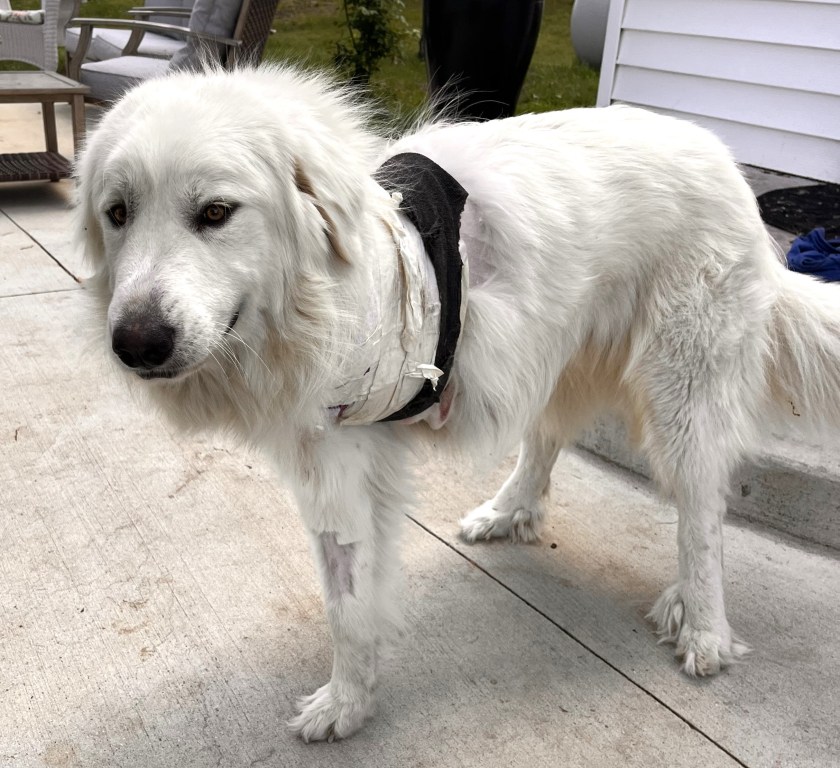
After three weeks, Pippin still could not put any weight on his left front leg. Perhaps his footpad needed to heal. Maybe nerves were damaged and needed to grow back. At first, the puppy just lay there. Like he was dying. Then he began to run around on three legs faster than I could run. We bandaged his leg. He tore the bandages off. His foot bled from him dragging it around and licking it too much. We recleaned and rebandaged his foot. We do physical therapy. We hold up his back legs, so that he needs to put weight on his front legs. He still doesn’t want to put weight on the injured foot. But he is alive. And he is his happy, gentle self. Even as he has grown bigger, he remains a gentle soul. He has the soul of an innocent child.
As a result of this incident, a new drive-way gate went up. The vet bills totalled $1,000. The gate cost $2,600 itself while I spent another $900 to have it installed. Thankfully the temperatures went up to 40 degrees during the winter so that the installer dared to lay cement. It normally takes cement eight hours to cure. We were only going to have a low of 29 degrees at night before it got up to a balmy 33 degrees. The cement cured even though the next seven days were below freezing. The installer set up the gate and put some rocks under the middle of the gate so that the weight of the gates would not pull the pillars out of place. I will need to finish running an electric fence up to the gate. Then, with the gate closed, we can make sure that Bear no longer trains Pippin in the art of chasing cars.
Three months later Pippin’s foot was no better. He still had no feeling on the lower part of his leg. Since he dragged his paw along on the ground, we needed to keep it covered. We bought various foot braces. He lost them. We put bandages around his foot and lower legs several times a day. He chews them off. We apply them again. All it takes is one time when his bandages are off and he runs over rough surfaces, and his wound is reopened. At one point his bones are visible. But the wound does not get infected. We wash and clean it daily.
The decision is made. Pippin will need to have his lower leg removed or he will need to be put to sleep. His great attitude saves him. Since he is such an affectionate dog, he gets a new lease on life. My wife brings him to the vet on a Monday morning to get his lower leg amputated. There is miscommunication. After driving an hour away, the veterinarian assistant merely takes an x-ray of the dog’s leg. Then she schedules the actual date for surgery–a week into the future.
We get concerned when the veterinarian tells us that after the surgery she wants to take the dog home to her house for observation all night. Are there problems? The following morning we picked up a drowsy dog. But he is happy to be home. He is in pain and wants to lay down.
His entire shoulder is missing. The doctor decided that she could not just remove the lower leg–so she surgically removed the dog’s shoulder and entire leg. After a couple of weeks of resting and recovering in the house, Pippin starts to get his energy and strength back. He is in pain for a few more weeks, although pain-killing medicine helps him feel better most of the time. After a month, his good spirits and health returned. He runs around on three legs. He is his exuberant, happy self. He is one of the Great Pyrenees who is blessed with the ability to smile with a wide grin.
It is cold today. Last night it was below zero. This morning I went to check on the water tanks. I had plugged in heaters in two of the 300-gallon tanks. One group of animals, composed of three steers, two heifers, and eight Lamancha goats, have one tank. I found that their tank was open in the middle. Light ice had formed around the outside. I dipped a metal bucket into the water to provide drinks for the two younger goats who cannot reach into the tank. I pushed down on an automatic waterer and discovered that it was tempted to stick in place. Stuck open. Not good. I might have to pour some hot water on it to get everything moving well again. Then I walked to another field where I have two 300 gallon tanks. I had put a heating element in just the metal tank. The water was almost down to the level of the heater. The Rubbermaid tank had a thick coat of ice, the thickest I have encountered all winter. It took the pickaxe to bust through the ice. I made a large enough hole so that I could dip the rest of the water out of it and carry it into the metal water trough. Any water that ended up on my coat or Red Wing boots immediately froze.
I can hardly see because water splashed up on my glasses while I was wielding the pickaxe and they are covered with splotches of ice. Meanwhile I have filled a feeding trough with corn out of a five-gallon bucket. But the cows seem confused and are not walking through the narrow gate opening to get back to the water tanks and the food trough. So I take a walk, hardly able to see, carefully walking on the frozen ground that is pitted from the deep steps of the cattle when the snow and ice melted a few days before. They catch on, and the cows greedily gather around the snack of corn. One of the calves is so thirsty that he is willing to come close to me as I continue to move water from the Rubbermaid trough to the metal one. It is good for the calves to become less scared of me–for the time will come when I need to move them. The adults hog the corn. The calves do not get an opportunity to get close to the feed trough. The wide bodies of the bull and the cows box out the younger generation.

